
History
Ancient Beykoz
The earliest known date in the history of the city of Beykoz is the 8th century BC. According to some historians, this date may go back even further. It is known, however, that the Thracians, a small tribe said to be of Indo-European origin, settled in the Beykoz region during this period.
This warrior community, which gave its name to Thrace, has no written culture. Although it formed strong governing mechanisms, it never became a single state. The Thracian people, who founded a state in the Beykoz region that they called Amykos, were attacked and defeated in 337 BC by the Bithynians, another tribe of the region.
The city of Beykoz, which had become a kingdom in the era of the Bithynians, saw nine kings. Bithynia was transferred to the Roman Empire in 74 BC by King Nicomedes IV. Soon after, it was occupied by the Kingdom of Pontus; as a result of a ten-year war between the Roman and Pontic armies, the Kingdom of Pontus too was joined to the Roman Empire by being incorporated into Bithynia.
Roman and Byzantine Periods
In AD 395, when the Roman Empire was divided into Western Rome and Eastern Rome, Beykoz remained within the borders of Eastern Rome (Byzantium). Beykoz, which held both commercial and military importance because it commands the part of the Bosphorus facing the Black Sea, passes into the hands of the Persian Empire in 609 and of the Muslim Arabs in 669. But after a short time it is taken back by the Byzantine Empire. This is a dominion that will last seven centuries, that is, until the arrival of the Ottoman Empire in 1402.
Ottoman Period
Sultan Bayezid the Thunderbolt captures the region exactly 51 years before the conquest of Istanbul. Thus the city takes the name Beykoz. According to the best known of many accounts, the name Beykoz was formed by combining the Persian word “kos”, meaning village, with the Turkish word “bey”, because the governor of Kocaeli (beylerbeyi) resided here. According to another account, it was formed when “Binkoz” was derived from the word “koz”, which then meant walnut, because of the large number of walnut trees in the region. In the Ottoman period the Beykoz region was one of the favourite places of the ruling class, with its recreation grounds, sea, fertile lands, forests and extensive hunting grounds. The sultans above all, and the palace circle, made this region their dwelling for hunting. In connection with this passion for hunting, hunting lodges and pavilions were built over time so that the sultans and the palace circle could stay.
From the 17th Century to the Present
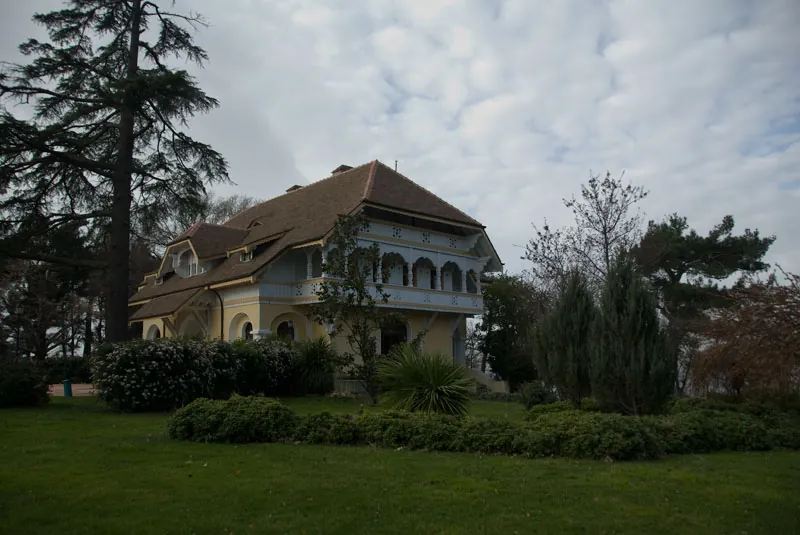
The sultan most devoted to hunting, for whom the nickname ‘the hunter’ was used, is said to be Mehmed IV (1642-1693). It is related that Mehmed IV’s shortest hunt lasted three months. Accused of neglecting affairs of state because of his passion for hunting, he moved his throne to Edirne. This passion continued among later sultans and the palace circle. In 1904 a religious scholar named Saip Molla Pasha had a hunting lodge built in the wooded area on the ridges of Beykoz. Its architect is the Italian architect Delfo Seminati, who also built the Khedive’s Pavilion. The lodge was given the appearance of the Villa of Toscana, which was in Italy in those years. Besides the sultans of the period, it also served the famous princes of the time who came from Europe and Egypt. Beykoz Konakları consists of 401 residences built in the forest, without felling trees, on the 100-hectare area where this historic Hunting Lodge stands. The Lodge, which was used by Abdülhamid II, Mehmed Reşad and Vahdettin, has been restored faithfully to its original. Today, the Hunting Lodge is used as the management building of Beykoz Konakları, and the Stables attached to it as social facilities.